
Today in Paris, UNESCO celebrates the official inauguration of 2025, the International Year of Quantum Science and Technology.
To mark this special occasion and join in celebrating quantum mechanics in this special 100 years anniversary, I will start a special series: Women of Quantum. I will profile women who made and/or are still making important contributions to this field.
As I have seen quite a few posts on social media citing Bell’s inequalities or Bell’s theorem, I decided to start with Grete Hermann, who laid the groundwork for entanglement way before Bell himself, but kept her arguments for private correspondence and published only on a minor publication in German.
Grete Hermann (1901–1984) was a German mathematician and philosopher. She defined herself as a humanist, and was openly politically active. She studied in Göttingen, where she completed her doctorate under Emmy Noether, who eventually said “she studies mathematics for four years, and suddenly she discovers her philosophical heart”. Later, she moved to Leipzig to explore the philosophical aspects of Quantum Mechanics, in particular the idea of causality as distinct from determine and predictability.
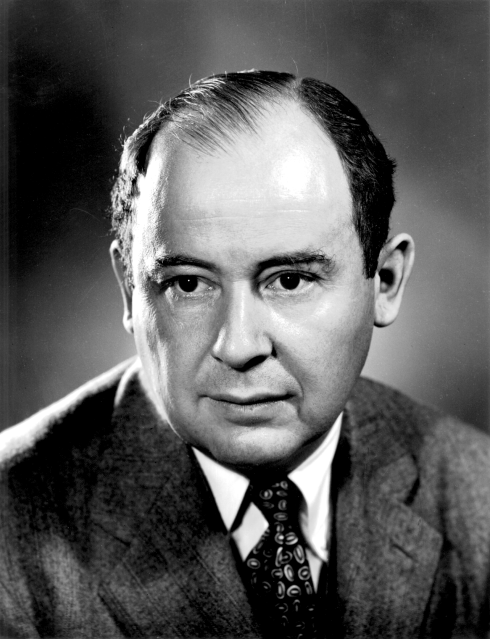
Causality is at the core of classical physics. If I kick a ball, it will move along a trajectory I can clearly determine by knowing the initial position of the ball and the exact angle and force I put into my kick. But in quantum mechanics, determinism (not causality!) vanishes. Instead of definite outcomes, we get probabilities. This troubled many early physicists—including John von Neumann, who argued in 1932 that quantum mechanics left no room for hidden variables that could restore determinism (the no-go theorem). This argument was used as a fort by Bohr and Heisenberg and everyone defending the Copenhagen interpretation.
Many physicists were skeptical of von Neumann’s claims, but challenging such a towering figure was considered heresy at the time. While some kept their oppositions to the no-go theorems for themselves and in private conversations, one person took it upon herself to point out a flaw in von Neumann’s argument. Grete Hermann worked hard to show how causality was still part of the quantum theory, and how different causality and predictability are.
In 1935, she analyzed von Neumann’s proof and discovered a critical flaw: his argument assumed that for any two physical quantities R and S, the expectation value of their sum must always equal the sum of their expectation values. Mathematically, this means: E(R+S)=E(R)+E(S) This assumption holds in standard quantum mechanics, but von Neumann incorrectly extended it to hidden-variable theories, where it does not necessarily apply.
Thirty years later, John Bell made the same observation, writing: “His [von Neumann’s] assumption is: Any linear combination of any two Hermitian operators represents an observable, and the same linear combination of expectation values of the combination. This is true for quantum mechanical states; it is required by von Neumann of the hypothetical dispersion-free states also.” This is exactly the same mathematical critique Hermann had formulated decades earlier. Yet while Bell’s argument transformed quantum foundations, Hermann’s was largely forgotten. She had already dismantled von Neumann’s claim that hidden variables were impossible—an insight that, had it been recognized, might have reshaped the debate on quantum mechanics long before Bell’s work.
However, she kept her discussion and proof mostly private, only sending it via letter, including to Einstein, Schrödinger, and Heisenberg. An excerpt was published with a small publisher and never translated from German. It is still unclear why, while these figures knew of Hermann’s arguments and insights, including how correct she was, nobody brought it up on a broader stage.
Hermann’s and Bell’s arguments are mathematically similar, but only in 1966, when the second one was taken under consideration by physicists, did we finally begin to see beyond the strict constraints of the Copenhagen interpretation. Only in 1974, Max Jammer pointed out how Hermann had preceded Bell into showing non-locality as part of the fabric of quantum mechanics, many years after Bell had published his theorem and inequalities.
It is hard to imagine what would have happened to our view on quantum mechanics and its implications. In particular, taking Hermann’s arguments into consideration already in the ‘30s might have sped up the understanding of quantum entanglement, together with a series of developments related to it, including quantum information.
Hermann was a big opponent of the Nazi party. She left Germany and lived in Denmark, France, and England. After the war, she went back to Germany and joined the Social Democratic Party (SPD). She was one of the minds behind the Bad Godesberg Programme, modernising the SPD and leading to their win in 1960.
While remaining a prominent philosophical and political figure in Germany, she never resumed her math and physics work.
The Grete Hermann Network of female researchers in condensed matter physics and neighbouring research areas honours her early discoveries.

 The Spin of Things


Leave a comment