This week, the Women of Quantum series covers one of my favorite experiments ever—one that reshaped physics but also exposed a glaring oversight by the Nobel Prize Committee.
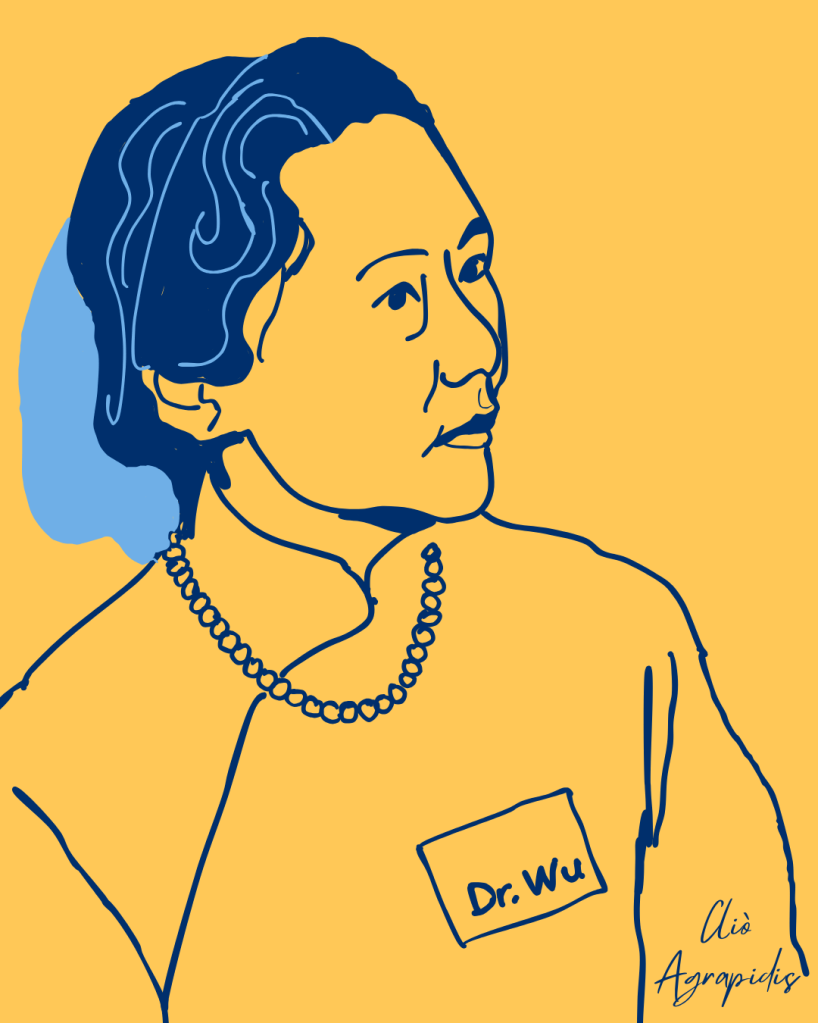
Chien-Shiung Wu was a Chinese-American experimental physicist, often called the “Chinese Marie Curie.” But those who knew her found her far more than that—worldly, witty, and brilliant, she was known as the “First Lady of Physics.”
Having moved from China to the US for her studies, she pursued a PhD at Berkeley, where she worked closely with Emilio Segrè. Their research on xenon would later provide crucial answers during a critical moment for the Manhattan Project. At Berkeley, she also met her future husband, physicist Luke Chia-Liu Yuan.
Wu’s greatest contributions came in nuclear physics, particularly in decay processes—most notably, beta decay. At the time, scientists debated its underlying mechanism. The problem was simple but troubling: electrons emitted in beta decay showed a continuous spectrum of energies, conflicting with classical expectations. Some suggested this meant energy conservation was violated. Others, including Wolfgang Pauli, proposed a different explanation: the existence of a new, electrically neutral, lightweight particle—the neutrino—that carried away the missing energy.
Wu wasn’t just an expert in beta decay—she redefined our understanding of it. When early experiments failed to match Enrico Fermi’s theoretical predictions of weak interactions, many physicists questioned the validity of his model. But Wu, confident in Fermi’s insight, suspected a flaw in the experimental approach.
The issue lay in how the beta particles were being measured. Thick radioactive sources caused electrons to lose energy before detection, distorting the results. Wu designed an improved setup using a thin copper sulfate film, eliminating this effect and proving that Fermi’s theory was correct. This breakthrough not only resolved a long-standing debate but also cemented Wu’s reputation as the foremost experimentalist in nuclear physics.
Her mastery of beta decay set the stage for an even more revolutionary discovery: proving that nature itself is not as symmetrical as physicists once believed.
Breaking the Mirror: the Parity Experiment

Get yourself in front of a mirror and wave at yourself with your right hand. Your mirror self will answer with their left one. In a perfectly mirrored world, everything—from turning a doorknob to the spin of an electron—should behave identically, just flipped. To reach grandma’s home, we would have to turn left rather than right, but dinner would taste equally delicious. This is the idea of the parity principle, the fundamental assumption that the universa does not favour left or right.
Formalised by Eugene Wigner in 1927, this principle was accepted as true for almost 30 years. There was no indication our world should have a left or right preference when it comes to microscopic forces and events. But what if it did? Proving Nature had a preference for left or right would fundamentally alter how we understand the universe’s fundamental forces, rewriting decades of accepted theory.
This foundational ideas of symmetry crumbled in 1956, when Prof. Chien-Shiung Wu proved that quantum forces do, in fact, have a favorite direction. Her goal was clear: use a natural decay reaction to check if Nature is indeed left or right handed.
She used the radioactive decay of cobalt-60 (Co-60) for her experiment. Wu’s precision was legendary—she personally polished the cobalt source used in her experiment, ensuring no detail was overlooked. Co-60 decays in nickel-60, an electron, an electron antineutrino and two gamma rays (photons). Gamma rays are governed by electromagnetic force and known to conserve parity. Wu used the gamma-ray direction as her guide to compare where electrons were emitted.
If parity held true, electrons would follow the same direction distribution as gamma rays. Instead, Wu observed that the electrons preferred a very specific direction of decay, dependent on the nuclear magnetisation of the cobalt atoms.
To run this science changing experiment, Wu gave up a trip to the far East with her husband and the possibility of meeting her father and her older brother, whom she would never meet again.
Her collaborators Tsung-Dao Lee and Chen-Ning Yang were awarded the Nobel prize in 1957 and recognised her role in their acceptance speech. But the prize was never extended to her. It would take two more decades before she received the Wolf Prize in Physics, one of the highest honours in the field.
Despite this oversight, Chien-Shiung Wu’s contributions reshaped physics. She inspired generations of scientists, fought against gender barriers in science, and left an indelible mark on our understanding of the universe.
Her legacy remains unshakable—just like the mirror she broke.
 The Spin of Things
Leave a comment