Today we take a different spin on how we interpret contributions to quantum mechanics and dive into the world of mathematics with Karen Uhlenbeck.
A life shaped by solitude and science
Karen Keskulla Uhlenbeck was the eldest of the four children of Arnold and Carolyn Keskulla. Sharing a childhood with four siblings was a challenge for Uhlenbeck, who enjoyed being by herself. She admitted part of what led her to choose her career path was the possibility of not having to work with other people. She frames this as a competition only with herself rather than with others.
Her father was an engineer and her mother was a schoolteacher. They both had college degrees and so it was assumed Uhlenbeck herself would also attend college. However, while she wanted to attend Cornell or MIT, her parents found those institutions too expensive and redirected her toward the University of Michigan. Here, she entered the honours program, which allowed her to attend very advanced classes already as a freshman.
From physics to mathematics: a defining shift in Karen Uhlenbeck’s career
Having spent her teenage years reading all of the science books available at her local library, she had enrolled at university for a major in physics. She did not know what math was then, as she believes one does not really encounter real math until college. For her, that was a poignant encounter, one that would make her switch her major and define her career path. The fact that this was a purely theoretical discipline with no lab work contributed to this switch.
An intellectual home—and a different kind of family support
In 1964, she married biophysicist Olke Uhlenbeck, the son of physicist George Uhlenbeck. Having an important academic as a father-in-law played a big role in Uhlenbeck’s life. She recalls how her in-laws valued intellectual things in a way her parents couldn’t. They still valued them, but they valued money more. This intellectual encouragement played a big role in her career.
Her husband was moving to Harvard and she had decided to pursue graduate studies, so she went to Brandeis, where she received a generous NSF fellowship during her first four years as a graduate student. Here, she focused on the study of the calculus of variations. In other words, she looked at how understanding small changes in one quantity could help us find the minimum or maximum value of another quantity.
Overcoming academic barriers: how institutions failed Karen Uhlenbeck
She then spent a brief period teaching at MIT and eventually moved to Berkeley, California. Here she submerged herself in the field of geometry and, in particular, the geometry of space-time and general relativity.
Despite an already bright career, the universities that wanted to hire her husband, including Stanford, Princeton, and MIT, did not offer her a position. They claimed “nepotism laws” that prevented hiring a spouse, but when she enquired about it several years later, they claimed not to remember saying this and there was no sign of such a rule in any document. Uhlenbeck believes they did not want to hire her because of being a woman.
She ended up accepting a position at the University of Urbana-Champaign, though she felt out of place there. She took the opportunity given to her by winning a Sloan Fellowship and reorganised her life. She moved to Chicago and worked with mathematicians of the Chicago Circle, including Jonathan Sacks. She then accepted a professorship at the University of Chicago.
Charting new paths in gauge theory and mathematical physics
Jonathan Sacks was her main collaborator for what many would say is her most influential work in mathematical physics. Together, they proved that solutions to Yang-Mills equations in four dimensions extend smoothly across isolated singular points, ensuring well-behaved solutions in spacetime. In simpler terms, they reassured physicists that the Yang-Mills equations—key to unifying electromagnetism and the weak force—behave well even at mathematical singularities.
Uhlenbeck’s contributions to mathematical physics came through the language of gauge theory—a framework familiar to any physicist studying electromagnetism. It already appears in entry courses on the topic. Electromagnetic phenomena are described by Maxwell’s equations. Certain mathematical manipulations, local transformations, do not affect the physical prediction of the theory.
Finding the right gauge can take a problem from unbreakable to understandable. By reformulating the Yang-Mills equations in the Coulomb gauge, Uhlenbeck made them tractable, enabling further advances in particle physics, from the Standard Model to quantum gravity.
Towards the end of the 1980s, she moved to the University of Texas in Austin. Here, she kept working at the boundary between math and physics, in close collaboration with Nobel Prize winner Steven Weinberg.
Looking at her career, she admitted to having covered a broad range of topics in math, from geometry to applied math, she moved from a topic to another always looking for things she found interesting and that she felt she could understand at least a little about.
Recognition, roles, and responsibility in the math community
In 1990, she gave the Plenary Lecture at the International Conference of Mathematics in Kyoto, Japan. She was only the second woman to have this honour, after Emmy Noether in 1932. Here, she talked about instantons, a special kind of solution to partial differential equations. First introduced by physicists, Uhlenbeck’s work was seminal and fundamental to the development of the theory by Simon Donaldson, who later won the Fields Medal for his work.
Recognition of her contributions culminated in 2019, when Uhlenbeck became the first woman to receive the Abel Prize, often regarded as the Nobel Prize of mathematics. The committee praised her pioneering work in geometric analysis and gauge theory, highlighting its deep impact on both mathematics and theoretical physics.
Building space for women in mathematics and academia
Besides her important contributions to mathematics and, correspondingly, theoretical physics, she spent the last half of her career as an advocate for women in math. Together with colleagues, she established the Women’s program at Park City, a program for women in mathematics at all levels, from undergrad to research. One of the reasons behind this choice was that established women in mathematics had not seen any need to establish special programs for women in math. They had hoped that once legal barriers were gone, women and minorities would naturally enter the field in greater numbers. However, it did not happen. And when they realised that, they decided to positively act.
“Very human”: a legacy of intellect and honesty
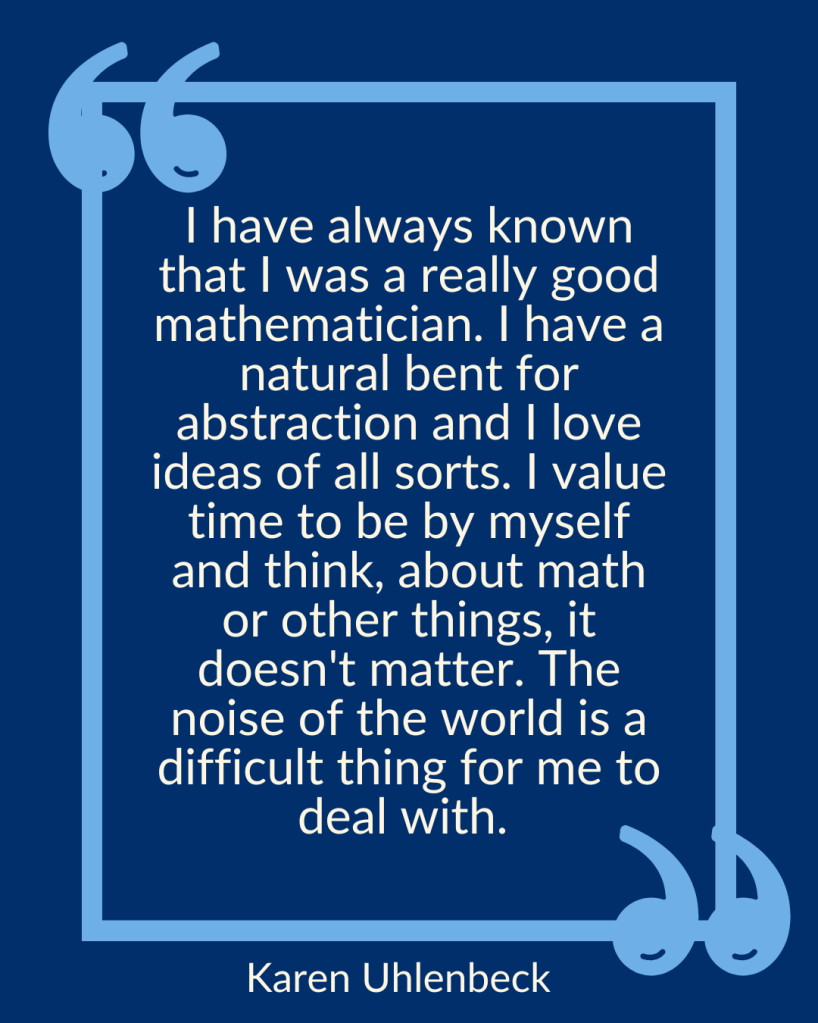
Uhlenbeck is aware of being a role model for girls and women in mathematics and she is aware of the weight that role carries. In her own words, “I may be a wonderful mathematician and famous because of it, but I’m also very human”.
 The Spin of Things
Leave a comment